Case Series — Amsterdam UMC
VACUTEX may be effective in wound healing through rapid capillary action: a case study
Marjolein Lust MSc — Nurse Specialist, Cardiothoracic Surgery, Amsterdam UMC
7
PATIENTS — CASE SERIES, JAN–OCT 2024
AMSTERDAM UMC CASE STUDY
45
AVG DAYS TO WOUND HEALING
≈€10
PER DRESSING CHANGE, AS REPORTED — VS ≈€100 PER VAC CHANGE
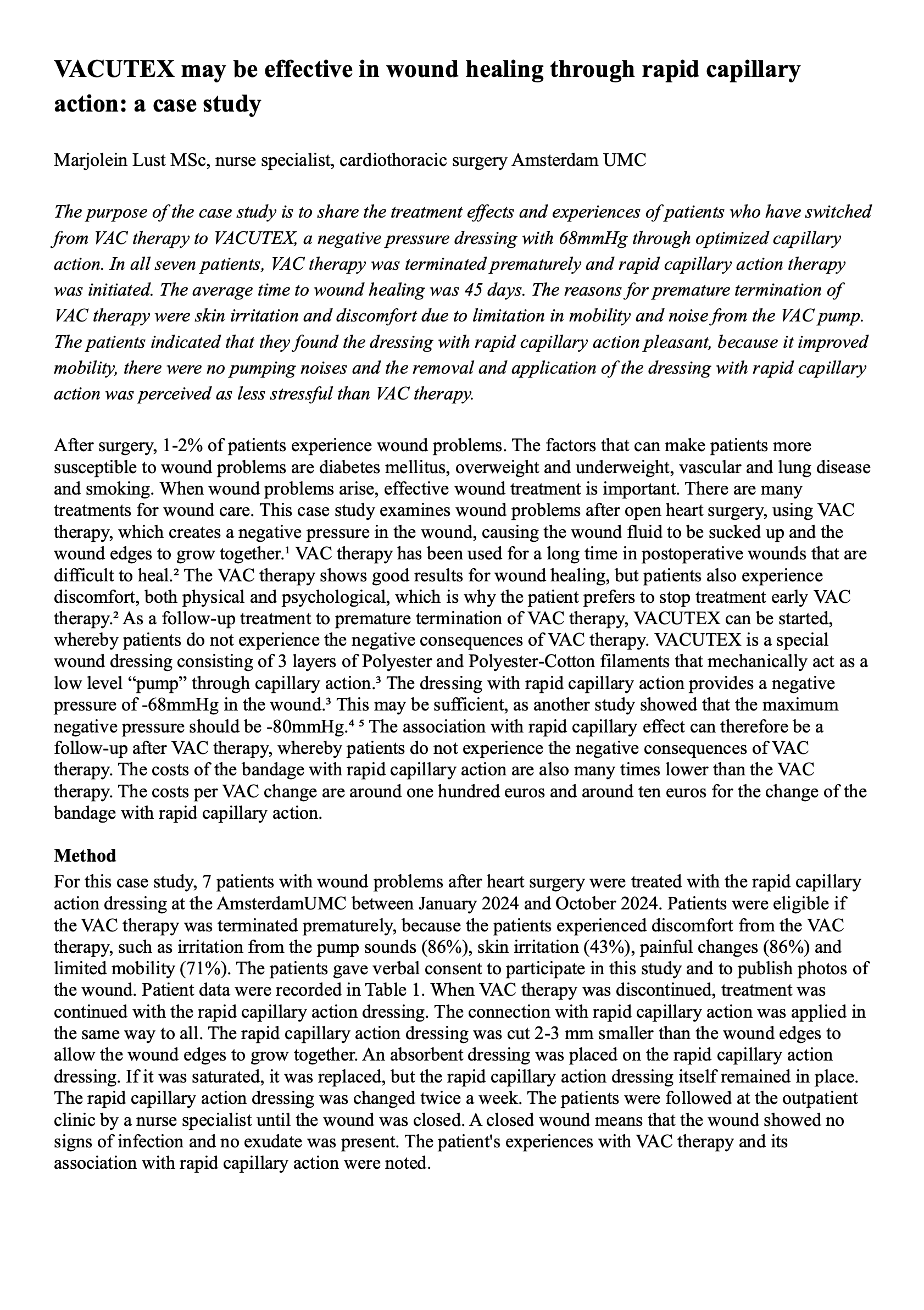
Between January and October 2024, seven patients with wound problems after open heart surgery were treated with the VACUTEX™ rapid capillary action dressing at Amsterdam UMC. In all seven, VAC therapy had been terminated prematurely. Patients reported irritation from pump sounds (86%), painful dressing changes (86%), limited mobility (71%), and skin irritation (43%).
Treatment continued with the rapid capillary action dressing, changed twice a week, until each wound closed — no signs of infection, no exudate present. The average time to wound healing was 45 days.
The author also reports cost. A VAC change runs around €100; a change of the rapid capillary action dressing, around €10. Patients found the dressing pleasant: mobility improved, there were no pumping noises, and removal and application were perceived as less stressful than VAC therapy.
The study's conclusion keeps its own careful language — VACUTEX may be effective in wound healing through rapid capillary action. It is not identical to Negative Pressure Wound Therapy but has an autologous mechanism like NPWT.
“All wounds were healed after treatment.”
- 6 STERNAL WOUNDS · 1 LEG WOUND
- VAC THERAPY AT 125mmHg — AVG 21 DAYS
- RAPID CAPILLARY ACTION (VACUTEX™) — MEAN 24 DAYS